October 7, 2026
My Dad worked for 30+ years for a company that grew from an entrepreneur selling products out of the trunk of his used car to a multinational, with offices in Japan, Canada, and Holland, with sub-assembly vendors all over the world. Salesmen criss-crossed the country both by car and their own private planes, which they flew themselves. The peak period was when this owner/entrepreneur called my Dad on a Sunday morning, and we all piled in to his LearJet and flew down to a Dallas Cowboys/NY Giants game, making an air trip that normally took 2+ hours (or a 4-hour car trip) in 30 minutes. For a grade-school kid, this was intoxicating stuff!
With runaway success and profits, eventually large corporations came calling with M&A offers, one of which was eventually accepted. Employees like my Dad, enriched on paper with stock options, suddenly found their stock converted to new corporate paper.
And with that, the beginning of the End.
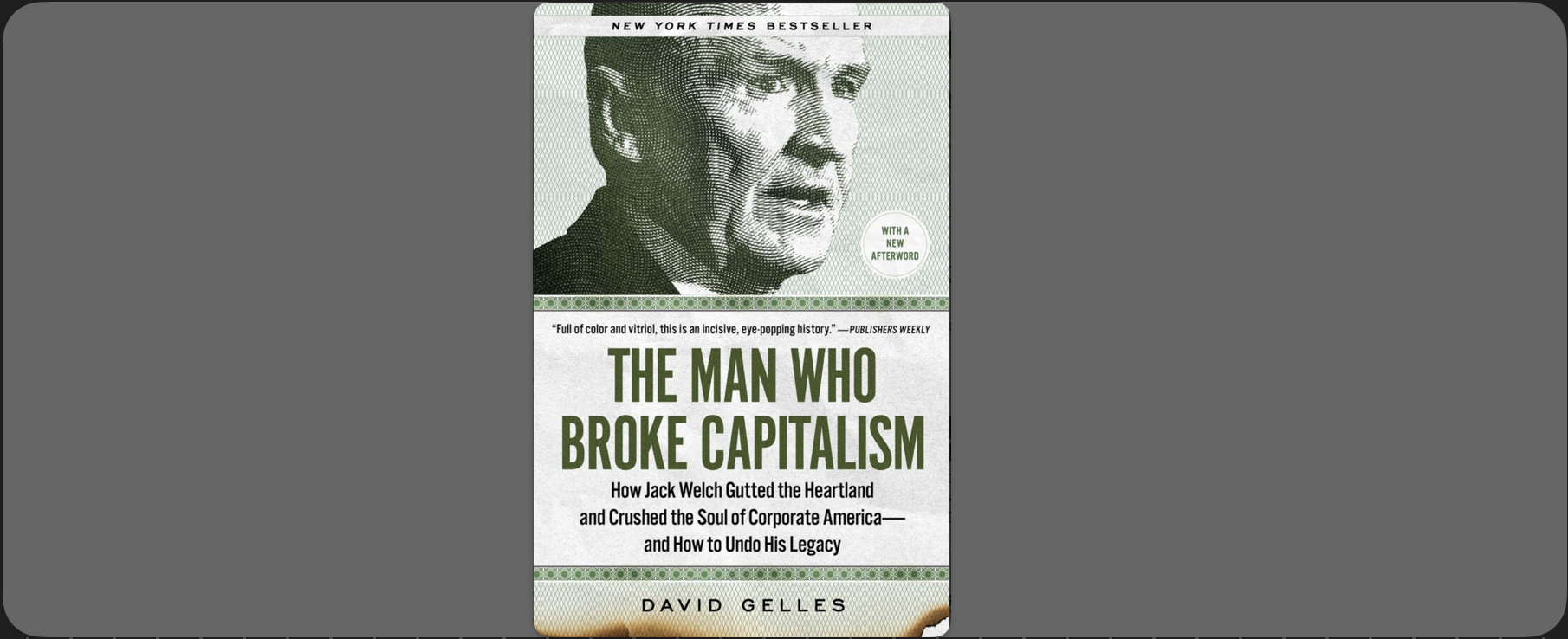
David Gelles’ book “The Man Who Broke Capitalism” was very uncomfortable for me. But it explains very well the world we now live in.
After all, I was a Business Major at that time, and I had in my heart that I too would join the paternalistic business that had been very good to my family and my town. I had the unfortunate timing to make this decision right as Jack Welch, “Neutron Jack,” the world’s first Celebrity CEO, had arrived at General Electric. In short order, he created an executive training program (Crotonville) that minted little Welches, who would then be fruitful and multiply, in companies all over the US and, sometimes, the world.
Welch had become a devotee of the Chicago School of Economists, particularly Milton Friedman, who remains a premier economic revolutionary of the Right. He advocated positions that destroyed the compact between the workers, the towns they lived in, and the company.
Jack Welch became infamous for his pithy sayings and concepts:
Rank & Yank – the bottom 10% of the employees would be let go
“Fix it, Close it, or Sell it” – self-explanatory
Offshoring – moving production to ever-cheaper overseas locations, like Mexico, China, Vietnam, India, etc.
He was a champion of the concept of Financialization, where a corporation whose historic product had been physical, industrial output became an engine of making money from money. GE Capital was an example of this. Originally it was designed as a way to allow Americans to buy new refrigerators or washing machines on credit, but it became the primary business. The target was 40% of the revenue and 60% of the profit. The primacy of the CFO over the CEO is a vestigial triumph of this thinking.
The other approach was endless Deal Making. Mergers & Acquisitions became the way to constantly inflate corporate worth. In some cases, subsidiary companies were encouraged to book intra-company transfers as sales; this would mean a new locomotive or airplane was marked as sold before it was even completed. A clear violation of Generally Accepted Accounting Principles.
Welch’s personal friend, Donald J. Trump, became enamored of this method, which for a real estate developer produced the endless balance-sheet shell game that we’ve seen in practice. In his later years, Welch lived in the Trump Tower and the two alpha-male capitalists hung out often.
The book is filled with stories not just of Jack Welch, but some of his well-known executives who fanned out to run Boeing, Ford, GM, and many others. The ones where he didn’t place new leaders were his acolytes, who took over VW, IBM, and Apple to name a few.
When my Dad’s company was bought by a well-known corporate name of the time, a new CEO was brought in. This CEO was a GE Crotonville graduate, and in less time than it took to create a great company with lots of employees, it was gone. The remnant of the original building was torn down not long ago. For those of us whose Dads worked there, the depressing symbol of this economic bomb to the middle class no longer even leaves a sign it was ever there.
The story of my hometown is not special. Many companies in many towns either got bought by corporate raiders and gutted, or management decided themselves that they (and their CFOs) needed to take the tax benefits of moving the factory to Mexico. The hollowing-out of countless towns big and small all look the same in the end.
Jack Welch proved how quickly a culture of financialization and cost-cutting could spread through American corporate life. But if bad ideas can spread through executive training programs, good ones can too. As companies like Costco and IKEA demonstrate, prioritizing workers and long-term stability isn’t just ethical—it’s sustainable business. The pendulum is starting to swing back; the only question is how quickly the rest of corporate America will follow.
Leave a Reply